As this year comes to a close and the new year approaches, I want to thank my Thai language students over the years. 2026 will mark two decades of me teaching Thai in New York. As I have written in previous posts, Thai is not especially difficult to learn, but it does require sustained dedication and time, in my experience, about a year of consistent study.
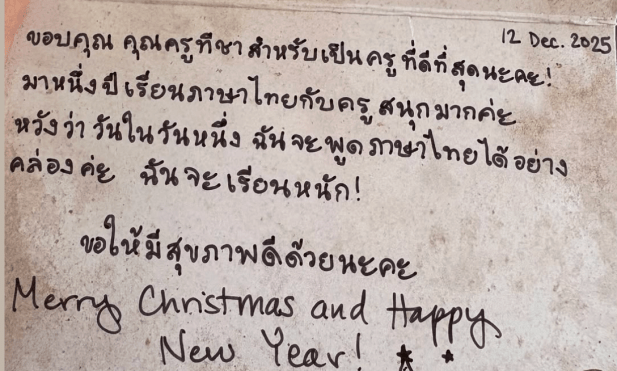
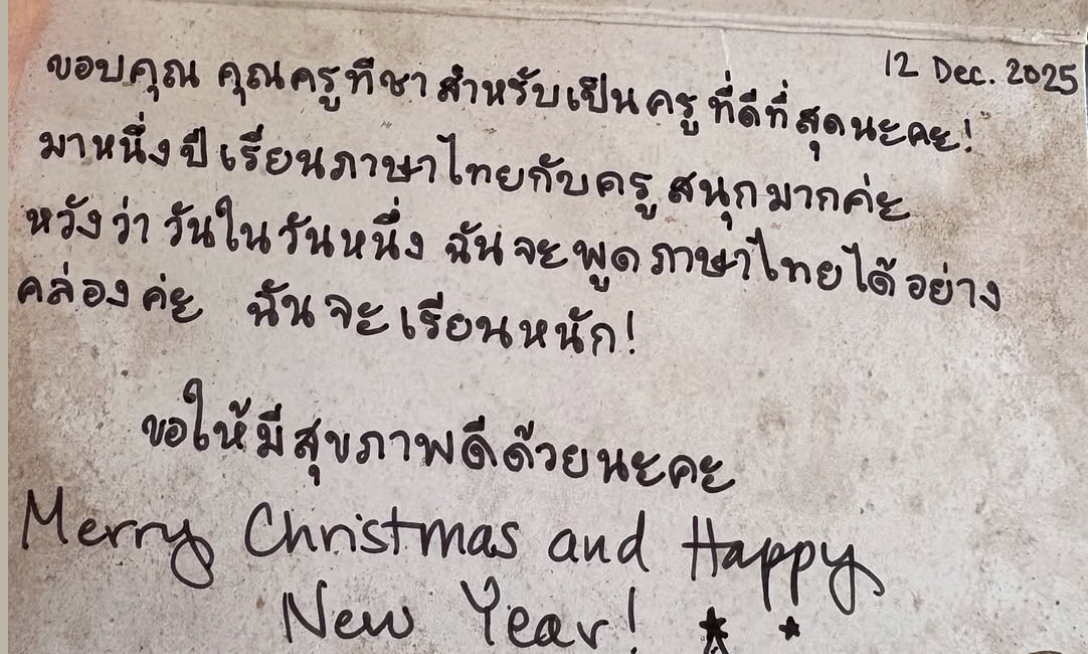
Here is a photo of a greeting card that one of my students gave me this month. It brings me great joy to see her communicate confidently in Thai through writing, reading, and conversation after a year of studying together.
Translation of the note: Thank you, Teacher Titcha, for being the best teacher. I have enjoyed studying Thai with you over the past year. I hope that one day I will be able to speak Thai fluently. I will study hard. I wish you good health.
This year has been quite an adventure for me. I’ve had the pleasure of working with new Thai language students and reconnecting with my former ones. Your support and patronage over the years mean so much to me, and I am truly grateful.
One exciting area I’m exploring with my students is integrating artificial intelligence (AI) into Thai language lessons. From my observations so far, generative AI tools like ChatGPT show promise but still have significant limitations when it comes to Thai. The results in Thai often contain inaccuracies, logical inconsistencies, and what’s known as “hallucinations”—far more than in English. Because of this, it’s clear that someone fluent in Thai is essential to review and refine the AI-generated output to make it sound natural.
Stemming from my full-time job and scholarly research in language teaching, I’ve been experimenting with having my students use AI for basic conversations and pronunciation practice. While the AI’s Thai speech currently resembles that of a half-Thai or a foreigner attempting the language, it still provides some value for beginners. It complements tools like Google Translate, which are often limited to shorter phrases and cannot engage in dynamic conversations. AI can also serve as an accessible practice partner for basic Thai, offering a new layer of interactivity. One concern I have is avoiding any discussions involving personal information when using generative AI. These tools collect data, and at this stage, we cannot be certain how that information might be used. My main advice is to steer clear of sharing anything personal or sensitive while using AI.
I will continue refining these methods and share updates on how these experiments evolve.
Stay tuned for more findings!
Picture: Hard-working cat at The 3 Aunties, a Thai Grocery Store in Woodside, Queens, NY.


 Practical Thai Learning